
A Complete Power Factor & Harmonic Solution
ISO 9001 - 2008 Certified Company


Protect your capacitors and ensure system stability in VFD-intensive environments with our 7% & 14% reactor solutions.
Request Quote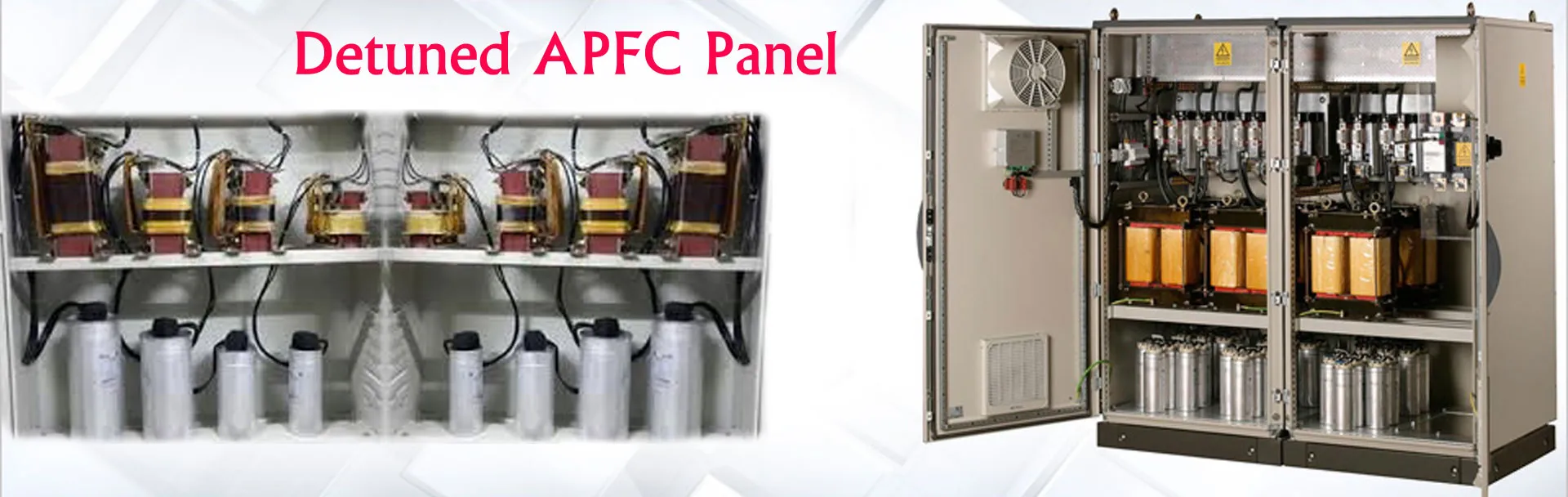
PS Power Controls is a premier Detuned APFC Panel Manufacturer in Chennai. In modern industrial setups featuring Variable Frequency Drives (VFDs), UPS systems, and large-scale LED lighting, harmonics are a major concern. A standard APFC panel can amplify these harmonics through resonance, leading to capacitor failure and system trips. Our Detuned APFC Panels are engineered with high-quality series reactors (7% or 14%) to safely mitigate harmonics and maintain a perfect power factor.
Blocks harmonic currents from entering the capacitors, preventing overheating and premature failure.
Significantly reduces Total Harmonic Distortion (THD) levels, improving overall power quality.
Designed with steel cabinets in extractable module design for easy maintenance and expansion.
Built to strict industry standards and CPRI tested for maximum safety and durability.
Our Detuned APFC Systems are customized for rapid and high load changes. Detailed specs below:
| Detuning Factor | 7% (189Hz) or 14% (134Hz) available |
|---|---|
| Capacity (Rating) | Customizable from 25 kVAr to 2000 kVAr |
| Reactors | Copper or Aluminum wound, low loss, high linearity |
| Capacitors | Heavy Duty MPP / Gas Filled (Higher Voltage Rated for reactors) |
| Controller | Intelligent Microprocessor-based with THD Monitoring |
| Enclosure | Powder Coated CRCA Steel, IP42/IP54 Protection |
| Components Brand | EPCOS (Siemens) / L&T Meher / Schneider |
Backed with a team of experienced professionals and a modern production unit, we offer highly efficient Detuned APFC Panels that strictly comply with set industry standards. These systems are built into steel cabinets constructed in extractable module design, making them suitable for applications with rapid and high load changes. Our panels are widely acknowledged for their sturdy construction, trouble-free operations, low maintenance, and high reliability.
Unsure if you need a Detuned Panel? Contact us for a professional harmonic analysis of your site.
ISO 9001:2008 Certified engineering for complex power quality issues.
Explore complementary power quality solutions to improve efficiency, reduce penalties, and improve equipment reliability.
APFC Panel | Active Harmonic Filter | Passive Harmonic Filter | Energy Audit Services | Get Technical Consultation
PS Power Controls supports end-to-end implementation across Chennai and Tamil Nadu, including load assessment, solution sizing, panel integration, and commissioning guidance. Our engineering recommendations are based on real operating conditions, utility penalty behavior, and site reliability priorities.
For project planning, combine this solution with energy audits, harmonic analysis, and consultation from our technical team. This approach improves power quality outcomes while reducing rework risk during deployment.